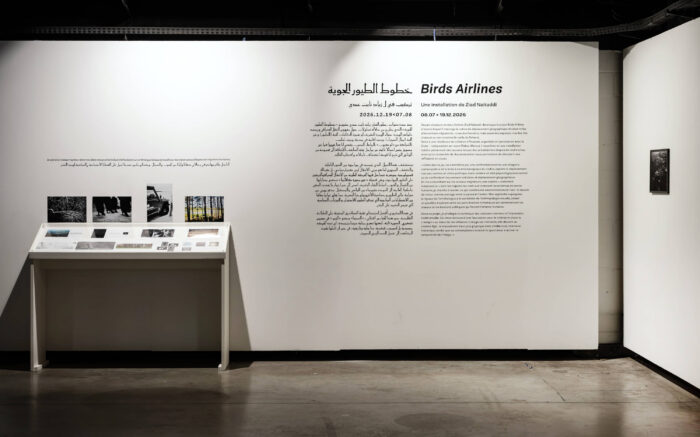
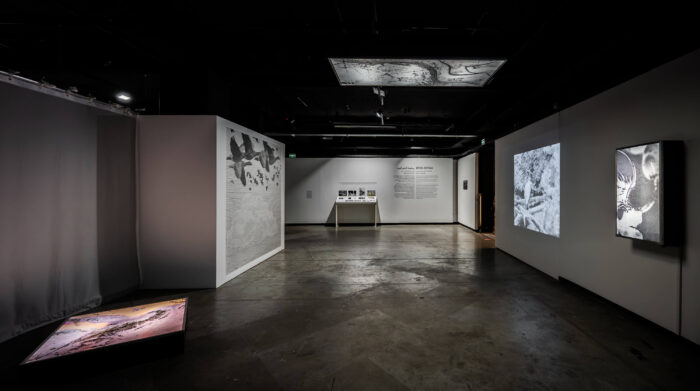
Following a series of research residencies dedicated to migration, conducted across Lebanon, Jordan, Austria, Switzerland, Portugal, Germany, France, and the United Arab Emirates, Ziad Naitaddi brings together, in this chapter of Birds Airlines, a constellation of archival materials, images, and data that he reworks and places in dialogue within a pared-back installation.
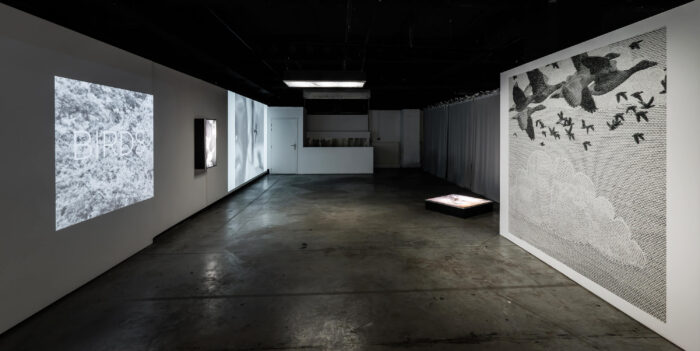
The project reflects on migration and movement from both philosophical and scientific perspectives. Throughout the installation, the recurring motif of wild geese serves as a conceptual thread. In Sweden, the geese accompanying a young boy on his journey across the country in Selma Lagerlöf’s The Wonderful Adventures of Nils have become an emblem of the Swedish passport—the very document that enables the crossing of borders.
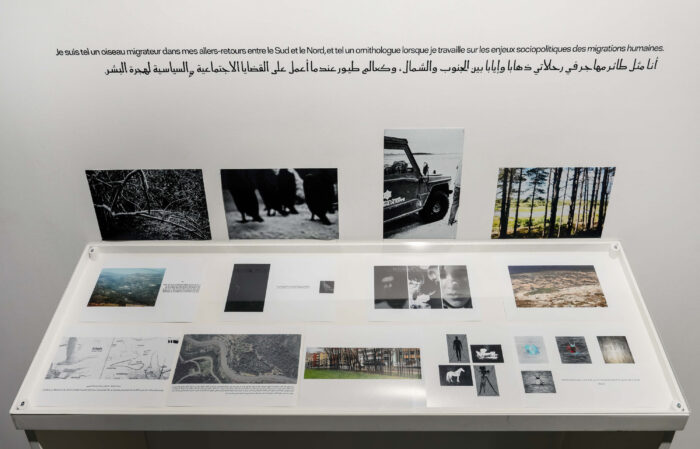
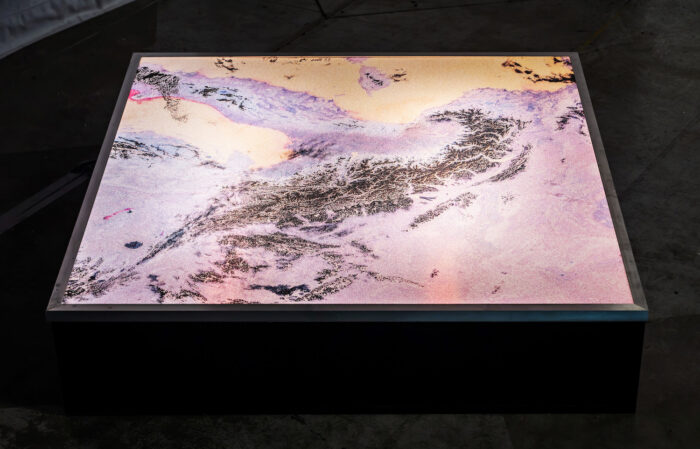
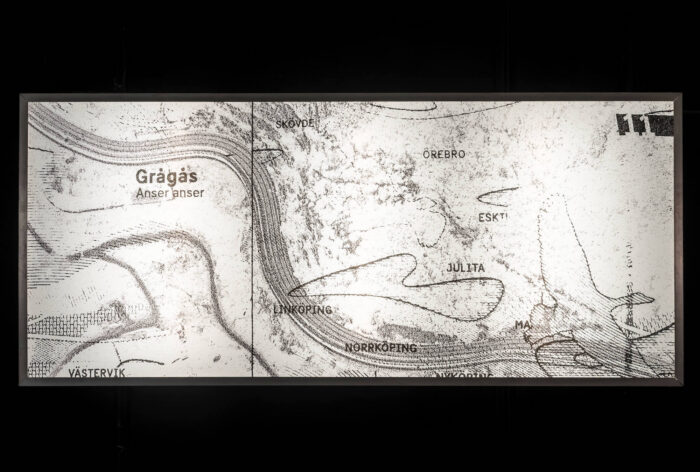
This motif resonates with a satellite image of a natural wetland in northern Sweden, a departure point for countless migratory birds travelling south. Today, the site has been severely affected by climate change and no longer provides a sanctuary for many species before or after their seasonal migrations.
Other images, drawn from different contexts and visual registers, trace the artist’s research trajectory, weaving together avian migration and human displacement. On one side, an aerial view of the border separating Morocco from the Spanish enclave of Ceuta captures the daily gathering of people waiting to cross in either direction. On the other, a photograph taken by the artist depicts a Lebanese landscape that has long served as a migratory corridor for pelicans and cranes. Now saturated with drones and missiles, Lebanon’s skies have largely been abandoned by these birds.
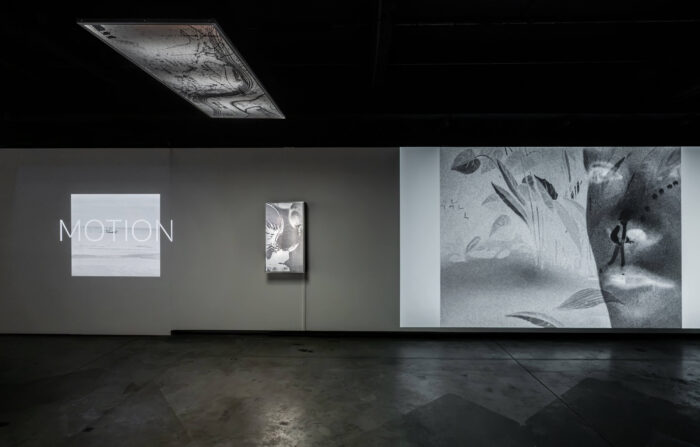
During his residency at La Condition Publique in Roubaix, organised in partnership with Le Cube – independent art room, Naitaddi worked alongside ornithologists and naturalists, accompanying them on field observations. At Lac du Héron in Villeneuve-d’Ascq, the Leers filtration ponds, and the coastline stretching between Dunkirk and Cap Gris-Nez and Cap Blanc-Nez, the artist immersed himself in these ecosystems while observing those who observe. Positioning his camera above their optical equipment, he films through their gaze and their instruments. The video presented here is an excerpt from an ongoing body of research initiated in Roubaix and destined to continue elsewhere.
(Ninon Duhamel, curator)
“This work takes shape through the encounter between contemplative imagery and the microscopic exposure of the visible, exploring displacement not as a political choice but as a fundamental physiological condition in which cellular movement and geographic migration become inseparable. By focusing on migratory birds—an ‘orally inexpressive’ species whose north–south trajectories invert human narratives of survival—I seek to examine the emotional structures that underlie exile: the desire to return as an anchor between past and future.
My approach overlays the methodological precision of ornithology with the sensibility of visual anthropology, establishing a compelling parallel between climatic disruptions that force birds into sedentary patterns and political conflicts that compel human wandering.
Throughout this project, I favour lightboxes over conventional photographic prints. This choice stems from a longstanding fascination with cinema and places time at the centre of the work. The image remains still, yet it becomes a suspended form of cinema: movement is no longer physical but intellectual, internal, and historical. Through contemplation, the viewer activates the image’s temporality.”
(Ziad Naitaddi)


expanded
Birds Airlines
© La Condition Publique & Le Cube - independent art room
photo: Frédéric IOVINO
© La Condition Publique & Le Cube - independent art room
photo: Frédéric IOVINO
© La Condition Publique & Le Cube - independent art room
photo: Frédéric IOVINO
© La Condition Publique & Le Cube - independent art room
photo: Frédéric IOVINO
© La Condition Publique & Le Cube - independent art room
photo: Frédéric IOVINO
© La Condition Publique & Le Cube - independent art room
photo: Frédéric IOVINO
© La Condition Publique & Le Cube - independent art room
photo: Frédéric IOVINO